
Chichicastenango Market: The Complete Guide to Guatemala's Most Iconic Indigenous Market
Chichicastenango: Guatemala's Greatest Open-Air Market
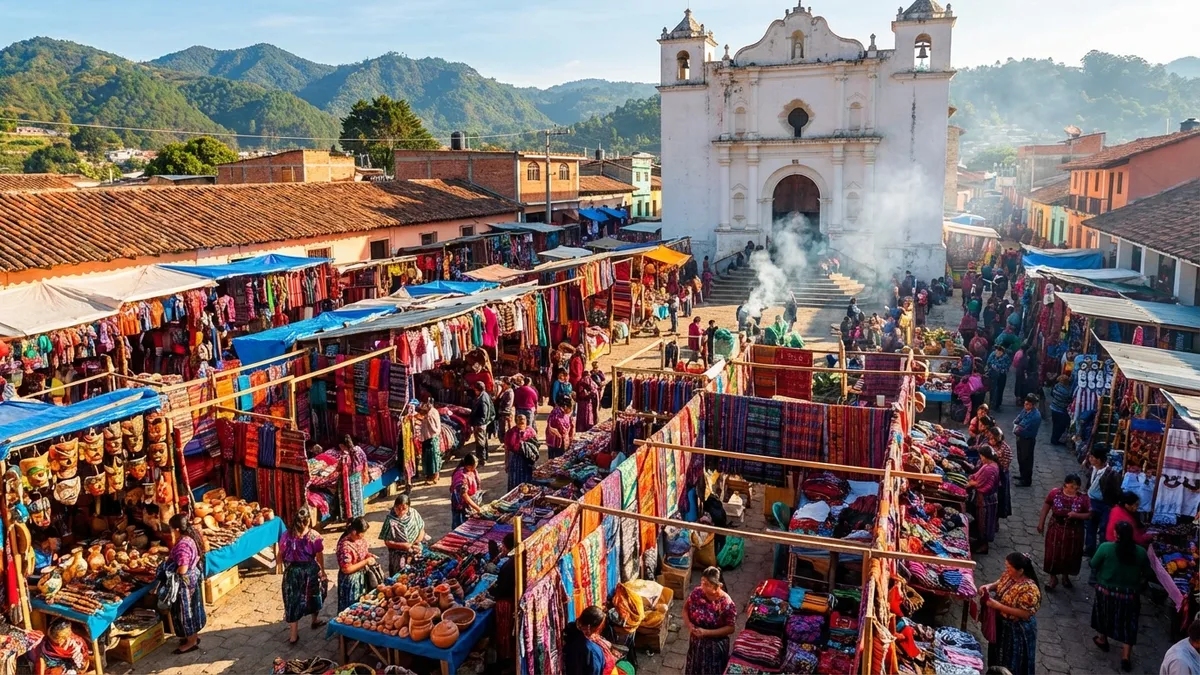
Twice a week, the highland town of Chichicastenango transforms into a kaleidoscope of color, sound, and living Maya tradition. Vendors drape hand-woven textiles across wooden stalls. Incense spirals up the steps of a colonial church where shamans conduct ancient ceremonies alongside Catholic priests. Thousands of buyers and sellers crowd narrow streets, haggling over jade carvings, hand-embroidered blouses, painted masks, and fresh produce. This is Chichicastenango market — one of the most extraordinary indigenous markets in the Western Hemisphere.
Known locally as Chichi, the town sits at 2,000 meters (6,500 feet) in Guatemala's Western Highlands, about 145 km northwest of Guatemala City and just 37 km north of Panajachel on Lake Atitlán. It has been a major K'iche' Maya trading hub since long before the Spanish arrived. Today it draws travelers from every corner of the world — but if you know how to navigate it, you can experience something far beyond a tourist market.
This guide covers everything: market days and hours, what to buy (and what to skip), how to bargain respectfully, the sacred Santo Tomás Church, Mayan spiritual ceremonies, day trip logistics from Lake Atitlán, and practical tips that most visitors never discover.
When Is the Chichicastenango Market?
The market runs on Thursdays and Sundays, with Sunday being the larger and more traditional of the two. Both days are worth attending, but Sunday draws a far greater mix of local indigenous vendors from surrounding villages, making it the richer cultural experience.
Market hours are roughly 7:00 AM to 5:00 PM, though many vendors begin setting up as early as 5:30 AM. The most authentic action — local traders buying and selling before the tourist crowds arrive — happens between 6:00 and 8:00 AM. The famous main square fills quickly by mid-morning.
If you want the full experience with fewer crowds, aim to arrive by 7:30 AM. If you prefer the market in full swing (more color, more energy, more stalls open), arrive between 9:00 and 10:00 AM. Most tour groups from Antigua and Guatemala City arrive between 10:00 AM and noon, so early is always better.
How to Get to Chichicastenango from Lake Atitlán
Chichicastenango is a natural pairing with a stay at Lake Atitlán — the two destinations are only about 37 km apart via the Pan-American Highway, making it an excellent half-day or full-day excursion.
From Panajachel (Lago de Atitlán)
The most common route is by chicken bus or shared shuttle from Panajachel. Chicken buses (repurposed American school buses) depart from the Panajachel market area and are the cheapest option — expect to pay under Q20 (about $2.50 USD) each way, with a journey of roughly 1.5 hours. Departures begin early on market days. Private shuttles can be arranged through most hotels in Panajachel, San Pedro la Laguna, or San Marcos la Laguna for Q150–Q250 per person round trip.
From San Pedro la Laguna
If you're staying in San Pedro la Laguna — home of Sababa Resort — you'll take a lanchas (boat taxi) to Panajachel first, then connect onward to Chichi. Alternatively, private shuttle services from San Pedro can be arranged directly, typically picking up guests at the main dock or resort entrance. The total journey is around 2 to 2.5 hours each way, making it a comfortable full-day trip.
From Antigua Guatemala
From Antigua, tourist shuttles run directly to Chichi on market days, taking about 3 hours. These can be booked through any travel agency in Antigua and often include a stop at a mirador (overlook) along the way.
What to See at the Chichicastenango Market
The Main Plaza (Parque Central)
The heart of the market surrounds Parque Central, the main square. Vendors arrange themselves in a chaotic-but-organized grid of wooden stalls and tarps. Textiles dominate the outer rows, while masks, ceramics, and jade fill the interior aisles. The produce market (mercado de verduras) operates on the eastern side and is largely for local shoppers — it's worth wandering through for the visual spectacle even if you're not buying vegetables.
Santo Tomás Church (Iglesia de Santo Tomás)
This 16th-century Dominican church is one of the most spiritually charged sites in all of Guatemala. On the 18 steps leading to its entrance, Maya ajqij (spiritual guides, sometimes called shamans) perform rituals with copal incense, candles, flowers, and rum — a living fusion of K'iche' Maya and Catholic traditions that has continued uninterrupted for centuries.
Visitors are welcome to observe from a respectful distance. Do not photograph the ceremonies without explicit permission — many ceremony participants find it deeply disrespectful. Remove your hat before entering the church, and enter only through the side door (the main entrance is reserved for ritual leaders). Inside, the floor is covered in flower petals and candles, and the air is thick with copal smoke.
El Calvario Chapel
Across the plaza from Santo Tomás, the smaller El Calvario Chapel sees similar syncretic ceremonies and is less visited by tourists, making it feel more intimate and authentic. The vendors near El Calvario tend to offer a wider range of ceremonial items.
The Mask Market
One of Chichi's most distinctive offerings is its hand-carved wooden masks, used in traditional danzas (ceremonial dances) throughout Guatemala. You'll find masks depicting Spanish conquistadors, animals, devils, and pre-Columbian figures. Authentic hand-carved masks are distinguished by their weight, the visible tool marks, and the natural wood grain. Mass-produced tourist masks are lighter, smoother, and often machine-cut.
What to Buy (and What to Skip)
Best Purchases at Chichicastenango
- Huipiles (hand-woven blouses): The most iconic item. Each huipil represents the specific village and family of the weaver through its patterns and colors. Look for genuine hand-woven pieces on a backstrap loom — the stitching will be slightly irregular and the fabric denser than machine-made versions.
- Table runners and tapestries: Easier to transport than full huipiles. Look for ikat-dyed or backstrap-woven textiles in deep reds, blues, and yellows.
- Jade jewelry: Guatemala has the only significant jade deposits in the Americas. Authentic Guatemalan jade ranges from deep green to lavender-grey. Test it — real jade feels cool and heavy. Many vendors sell dyed marble, so buy from reputable stalls or certified jade shops.
- Hand-painted ceramics: Traditional Guatemalan pottery often features Mayan symbols, animals, and geometric patterns. Look for pieces that feel substantial and have hand-painted (slightly imperfect) designs.
- Carved wooden masks: If you find a piece that speaks to you and shows signs of hand-crafting, it makes an exceptional souvenir and art piece.
- Copal incense and ceremonial candles: Widely sold and deeply authentic to local practice. Inexpensive and very aromatic.
What to Skip or Buy Cautiously
- Machine-embroidered textiles: Many items are factory-made imports from China or Mexico. Look closely — uniform stitch spacing and synthetic fabric are telltale signs.
- "Antique" Mayan artifacts: Genuine pre-Columbian artifacts cannot legally be exported from Guatemala. What's sold as antique is almost always a reproduction. Buy reproductions openly as reproductions — they can be beautiful, just don't overpay.
- Cheap plastic trinkets: These exist throughout the market for the package-tour crowd. Skip them entirely.
How to Bargain Respectfully
Bargaining is expected at Chichicastenango, but it should be done with respect, not as a sport. The weavers and artisans who sell here have invested days or weeks of skilled labor into their products. A good rule of thumb: don't offer less than 70–75% of the asking price, and accept gracefully when a vendor holds firm. If you genuinely want an item, pay a fair price. If you're just testing prices, don't start a negotiation you're not willing to finish.
Speaking even a few words of Spanish — "¿Cuánto cuesta?" (How much?), "¿Tiene descuento?" (Do you have a discount?), "Está muy caro" (It's very expensive) — shows respect and often results in better prices than arriving with a phrase card or relying on a guide to translate.
Many vendors also speak some K'iche' Maya, and knowing ma'aloob (thank you in K'iche') will earn you a genuine smile every time.
The Spiritual Life of Chichicastenango
Beyond the market stalls, Chichicastenango is one of the most important centers of living Maya spirituality in Guatemala. The K'iche' Maya calendar is still actively followed here, with ajqij (day-keepers and spiritual guides) reading fortunes, conducting healing ceremonies, and performing fire rituals at specific sacred sites around town.
The Shrine of Pascual Abaj, about a 20-minute walk from the market up a forested hill, is an ancient Mayan idol where fire ceremonies take place regularly. The climb is easy, and you may witness an active ceremony if you time it right. Again — observe quietly, don't photograph without permission, and leave an offering if you feel moved to do so.
The convergence of Catholicism and Maya religion at Chichicastenango is not a performance for tourists. It is a living tradition that has survived conquest, colonialism, and civil war. Approaching it with genuine curiosity and humility will result in an experience no guided tour can replicate.
Combining Chichicastenango with Lake Atitlán: The Perfect Guatemala Itinerary
The classic Guatemala highlands trip pairs two to four nights at Lake Atitlán with a market-day excursion to Chichicastenango. The combination works beautifully because the landscapes complement each other — the volcanic grandeur of Atitlán contrasts with the dense, atmospheric highland market town.
A suggested structure for a 4-night Atitlán-Chichi trip:
- Day 1: Arrive at Lake Atitlán, check into Sababa Resort in San Pedro la Laguna. Sunset swim and dinner.
- Day 2: Explore San Pedro — coffee farms, volcano hike, kayaking on the lake.
- Day 3 (Thursday or Sunday): Early boat to Panajachel, shuttle to Chichicastenango for the full market experience. Return by late afternoon.
- Day 4: Village-hopping by boat — San Marcos la Laguna for yoga and temazcal, Santiago Atitlán for artisan workshops.
- Day 5: Departure from Panajachel or shuttle back to Antigua/Guatemala City.
This itinerary captures the very best of Guatemala's highland experience without rushing anything. And because Sababa Resort offers transport coordination, arranging your Chichi shuttle is as simple as asking at the front desk the evening before.
Practical Tips for Visiting Chichicastenango
What to Wear
Dress in layers. The highlands can be chilly in the early morning (especially November through February) and warm by midday. Comfortable walking shoes are essential — the market streets are cobbled and can be slippery when wet. Carry a small daypack for purchases.
Money and Payment
Bring cash in Guatemalan quetzales (GTQ). Very few market vendors accept cards or foreign currency. ATMs exist in Chichi town (Banrural on the main square is reliable), but they can run out of cash on busy market days. Withdraw before you go. Budget Q400–Q800 ($50–$100 USD) for a solid shopping session, more if you're buying multiple textiles or jade.
Food at the Market
The market has excellent street food. Look for tostadas with black bean and chirmol, grilled corn with lime and chile, and atol de elote (a warm corn-based drink). The covered food section on the east side of the market offers full comida corrida (set meals) for under Q30 ($4 USD). Hygiene is generally good at the established food stalls — look for the busiest ones with local clientele.
Photography Etiquette
Always ask before photographing people, especially during religious ceremonies. Many vendors and locals prefer not to be photographed, and some will actively object. A simple "¿Puedo tomar una foto?" (Can I take a photo?) shows respect. Some vendors will ask for a small payment, which is entirely reasonable. The market as a whole — stalls, textiles, the streets — is freely photographable.
Safety
Chichicastenango is generally safe for tourists. Keep valuables in a front pocket or concealed daypack. Be aware of your surroundings in the densest areas of the market. Avoid displaying expensive cameras or jewelry ostentatiously. As with any crowded market anywhere in the world, petty theft targeting distracted tourists can occur.
FAQ: Chichicastenango Market
What days is the Chichicastenango market open?
The Chichicastenango market takes place every Thursday and Sunday. Sunday is the larger market day with more vendors and a fuller cultural experience. Both days run from approximately 7:00 AM to 5:00 PM.
How far is Chichicastenango from Lake Atitlán?
Chichicastenango is approximately 37 km from Panajachel (the main lake gateway), about a 1 to 1.5 hour drive. From San Pedro la Laguna, add a 30–45 minute boat ride to Panajachel. Total travel time from San Pedro to Chichi is roughly 2 to 2.5 hours.
Is it worth visiting Chichicastenango?
Absolutely. It's one of the most authentic and visually spectacular cultural experiences in all of Central America. Even if you don't plan to shop, the spiritual ceremonies at Santo Tomás Church, the riot of colors in the market, and the living K'iche' Maya culture make it an unforgettable day trip from Lake Atitlán.
What is the best time to arrive at the Chichicastenango market?
7:00–8:00 AM is ideal. You'll see local traders before tour groups arrive, the light is beautiful for photography, and the most dedicated vendors have the freshest selections. By 11:00 AM the market is at its busiest and most crowded.
Can I take photos at the Chichicastenango market?
You can photograph the market, stalls, and general scenes freely. However, always ask permission before photographing people, and never photograph religious ceremonies at Santo Tomás Church or El Calvario Chapel without explicit consent. Respect is non-negotiable here.
What currency is used at the Chichicastenango market?
The market operates entirely in Guatemalan quetzales (GTQ). Bring cash — most vendors do not accept credit cards or US dollars. There is an ATM at the Banrural branch on the main square.
How do I get to Chichicastenango from Antigua?
Tourist shuttles depart from Antigua on market days (Thursday and Sunday), taking approximately 3 hours. Shuttles can be booked through any hotel or travel agency in Antigua and typically cost $15–$25 USD round trip.
What should I buy at the Chichicastenango market?
The best purchases are hand-woven huipiles and textiles, genuine jade jewelry, hand-carved wooden masks, and hand-painted ceramics. Look for signs of hand-crafting (slight imperfections, natural materials, heavier weight) to distinguish authentic artisan goods from factory-made imports.
Plan Your Visit from Sababa Resort
Staying at Sababa Resort in San Pedro la Laguna puts you in the perfect position to experience Chichicastenango without the stress. Our team can help arrange shuttle transfers, suggest the best market vendors for authentic textiles, and pair your Chichi excursion with other highland adventures — from Volcán San Pedro hikes to boat tours of the lake's eleven villages.
Chichicastenango on a Sunday morning, with fresh coffee, a light mist rolling over the highlands, and the smell of copal incense drifting from the church steps — it's the kind of experience that makes Guatemala unforgettable. We'd love to help you get there.
"The market at Chichicastenango is not just commerce — it is culture, ceremony, and community woven together. Come ready to be surprised."